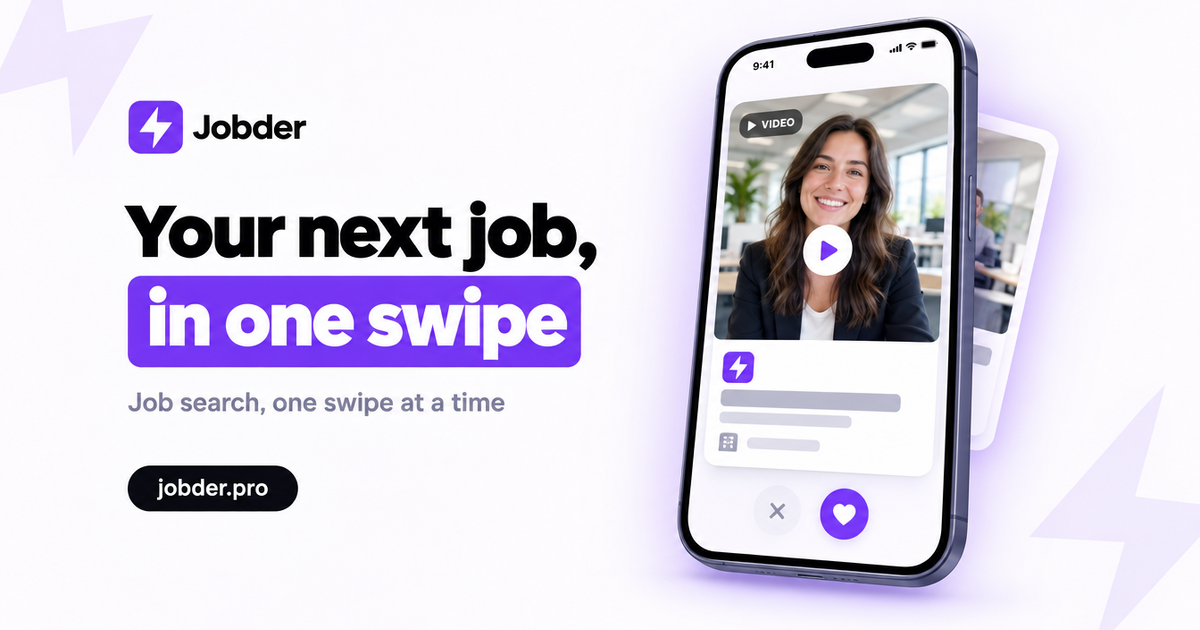
Jobder doesn't rank people with AI. Employers make the decisions. They can show the workplace, the team, or a shift in an optional short job video, and candidates can choose to share a video of themselves with employers. Video is optional on both sides. Job seekers decide on one job at a time. Employers review applications with a yes or a pass. On jobs employers post on Jobder, those two yeses create a Mutual Match; after that Match, both sides can message each other in Jobder. It's free to sign up at jobder.pro.
The problem people already feel
Ask almost anyone who has looked for work recently and you'll hear a version of the same story. They polished a resume, tailored it for the posting, hit submit, and never heard anything back. Not a no. Just nothing.
Part of that silence comes from how applications are handled at scale. Many employers use applicant tracking systems, usually called ATS, to collect and sort applications. Those tools do real work for teams that receive hundreds of applications per opening. But for the person applying, the process can feel like writing for a machine: guessing which keywords the software wants, reformatting a PDF so it parses cleanly, and hoping a filter doesn't drop you before a human ever reads your name.
Employers feel it too, from the other side. A small-business owner hiring a cook, a cashier, or a front-desk lead wants to know whether someone will show up, get along with the team, and handle a hard day. Those things rarely show up in a keyword match. A good person who described their experience in different words can quietly slip past.
What the industry's own numbers say
We don't publish statistics about Jobder, and we won't make them up. But other companies in hiring have shared numbers that explain why so many people feel unseen.
- Most applicants never hear back: Marketing Dive reported on June 3, 2026 that Harris Poll surveys commissioned by Indeed found 81% of people who apply for a job never hear back from that company, and 53% assume they won't get a response. (Checked November 2, 2026.)
- AI features now drive most sponsored applications at Indeed: In the same article, Marketing Dive reports that, according to Indeed's announcement, 70% of sponsored applications on Indeed are now pulled through AI features such as Smart Sourcing and Smart Screening, while less than 30% come from traditional keyword-based search. Indeed's own new campaign opens with the line "job searching doesn't feel human anymore." (Checked November 2, 2026.)
- Few applicants get past the first screen: The Swipejobs homepage, citing 2026 platform data from Greenhouse, says only 7.6% of applicants get past the first screen, down from 22% in 2022. Swipejobs builds AI matching itself and makes the case for doing it differently. (Checked November 2, 2026.)
We're not saying AI is evil, or that these companies are doing something wrong. Many teams use AI tools carefully, and people still make the big decisions. We simply made a different product choice: on Jobder, people choose people.
What we do instead: three steps
Jobder is built around a short, human process. Here's how it works.
- Step 1, Swipe: You see one job, or one person, at a time. You look, you decide yes or no, and then you see the next one. No one is sitting in a pile waiting for a filter to decide whether they get seen.
- Step 2, Optional video: Employers can add a short workplace video to a job card, showing the kitchen, the shop floor, or the team. Candidates can also choose to share a video of themselves with employers. Neither is required: a job can be posted without video, and a candidate can apply without recording one.
- Step 3, Mutual Match: When both sides say yes, it's a Mutual Match. That's it. Nobody gets pushed up or buried by a score. Interest has to come from both people.
The point isn't speed or volume. It's that every match starts with two people actually choosing each other, not with software deciding who is worth a look.
Why this matters for employers
If you run a small business, you probably don't need a stack of keyword-sorted applications. You need a few good people who want the job you actually have. A clear job post and an optional short workplace video tell candidates what the work is really like, and the people who say yes have already seen it.
A keyword filter can skip a great line cook who learned on the job or a reliable cashier whose resume is one page long. Looking at people one at a time gives you a fair chance to notice them. If you're new to this model, start with what swipe-style hiring is, then see which jobs benefit most from a video job post.
Why this matters for job seekers
You shouldn't have to game software to be seen. On Jobder, you look at real jobs one at a time, watch the workplace video when an employer has added one, and say yes to the roles that fit. If the employer says yes too, you have a Mutual Match with someone who actually chose you.
You'll still want a clean, honest resume for applications elsewhere. We wrote about that in Stop writing resumes for robots.
What we don't claim
Being people-first also means being honest about what we're not promising.
- No hire-in-hours promises: We don't promise you'll hire or get hired by a certain time.
- No AI shortlist or score: Jobder doesn't rank, score, or shortlist people with AI.
- No match guarantees: A Mutual Match needs two yeses. We can't promise either one.
- Pricing: Free to sign up; employers start with a free trial, then choose a paid plan.
- No inflated numbers: We don't publish user counts or job counts on this page.
FAQ
Does Jobder use AI to rank candidates?
No. Jobder doesn't rank people with AI. You see one job or one person at a time, and a Mutual Match happens only when both sides say yes.
Is Jobder an ATS?
No. Jobder is swipe-style job matching. It isn't an applicant tracking system, and it doesn't replace one for teams that need it to manage high application volume.
Is Jobder free to sign up?
Yes. Free to sign up. Employers start with a free trial, then choose a paid plan.
Do job seekers have to record a video?
No. You do not need to record a video to apply. Employers can add an optional short workplace video to a job card. Candidates can also upload a video of themselves and choose to share it with employers. Both are optional.
Is Jobder the same as Jobber?
No. Jobder (jobder.pro) is swipe-style job matching. Jobber is an unrelated company that makes field-service software. Read more in Jobder vs. Jobber, or email support@jobder.pro.
Get started
Hiring and job searching should start with people. Swipe one at a time, see the real workplace when there's a video, and match only when both sides say yes. Sign up free on Jobder.